UAVs, drones, and flycams are increasingly used for filming, photography, surveying, construction monitoring, and many other civilian activities. However, at airports and surrounding areas, using flying devices in violation of regulations can affect aviation security and safety as well as flight operations. Noi Bai International Airport advises residents, passengers, and relevant organizations and individuals to proactively check no-fly zones, restricted flight zones, and the necessary conditions before conducting any flight activity.
Recently, there have been incidents involving UAVs and drones appearing in airport areas, affecting operations and creating potential risks to aviation safety. At Noi Bai International Airport alone, a UAV that appeared near the airport in June 2026 affected 16 flights.
Most recently, at around 8:30 on August 30, authorities detected a flycam operating in Quang Minh Industrial Park, Quang Minh Commune, Hanoi. At the time of detection, the device was at an altitude of about 92 m, approximately 4.5 km from Noi Bai International Airport, and within the no-fly zone.
Upon verification, the device was being used to inspect and monitor the progress of factory construction at Quang Minh Industrial Park. The Noi Bai Border Guard Police coordinated with the Quang Minh Commune Police to stop the incident, prepare a case file, temporarily seize the device, and hand it over for further handling in accordance with regulations.
The incident shows that using a flycam for work, filming, photography, surveying, or construction monitoring does not mean it can be flown anywhere. Especially at airports and surrounding areas, users need to carefully check their location before conducting any flight activity.
How do no-fly zones and restricted flight zones differ?
Put simply:
- No-fly zone: Flights are absolutely prohibited at all altitudes, except for official government flight operations.
- Restricted flight zone: Flight activities must go through the permit application procedures as prescribed, even at altitudes below 120 m.
For airports with two or more runways, the prohibited area is limited to a rectangular zone, determined from the threshold position of the farthest runway in the direction of aircraft takeoff and landing, extending outward beyond both ends of the runways up to 15,000 m and extending 5,000 m to each side from the centerlines of the two outermost runways, at all altitudes.
The restricted flight zone is the area adjoining the no-fly zone at airports and aerodromes with civil aircraft or military aircraft activity, extending outward 3,000 m in width and 5,000 m in length from the boundary of the no-fly zone at the airport or aerodrome, at altitudes below 120 m above the terrain.
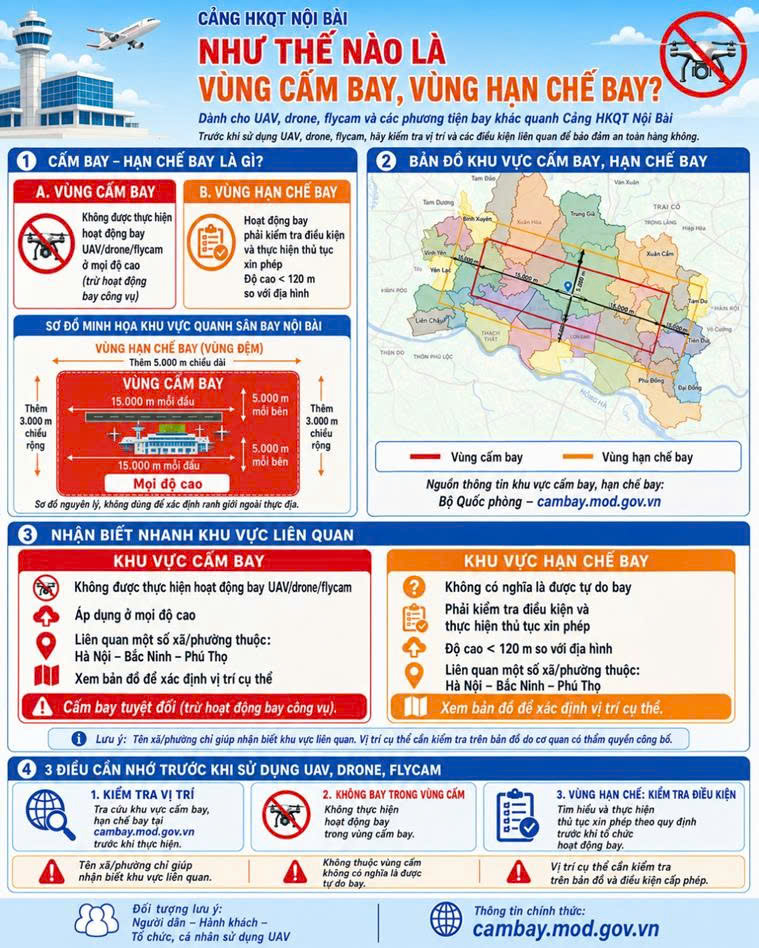
Before using a UAV, drone, or flycam, remember 3 things
1. Check your location
Look up the no-fly and restricted flight zone map at cambay.mod.gov.vn before conducting any flight activity. Information on no-fly and restricted flight zones for unmanned aircraft and other flying vehicles is published by the Ministry of National Defense at this address.
Alternatively, scan the code provided by the Noi Bai Border Guard Police to find current regulatory information.

2. Do not fly in no-fly zones
If your intended location is within a no-fly zone, do not operate a UAV, drone, or flycam.
3. If in a restricted zone, check the conditions and complete the required procedures
Users need to learn the relevant requirements and apply for permission before conducting flight activities.
Please note that being outside a no-fly zone does not mean you are free to use a UAV, drone, or flycam. Before every flight, operators must still check their location, conditions, and relevant regulations.
Noi Bai International Airport advises residents, passengers, and relevant organizations and individuals to proactively check information before flying; not to conduct flight activities in no-fly zones; and, for restricted flight zones, to check conditions and fully complete the procedures as prescribed.