Domestic Passenger Terminal (T1)
The Domestic Passenger Terminal (T1) was put into operation in October 2001, with the original design comprising four areas: Concourse A, Concourse B, Concourse C, and Concourse D, with a total floor area of 90,000 square meters and a handling capacity of 6 million passengers per year. At the end of 2013, Concourse E (the extension of Terminal T1) was brought into service, increasing the total floor area to 115,000 square meters and raising the terminal’s handling capacity to 15 million passengers per year.
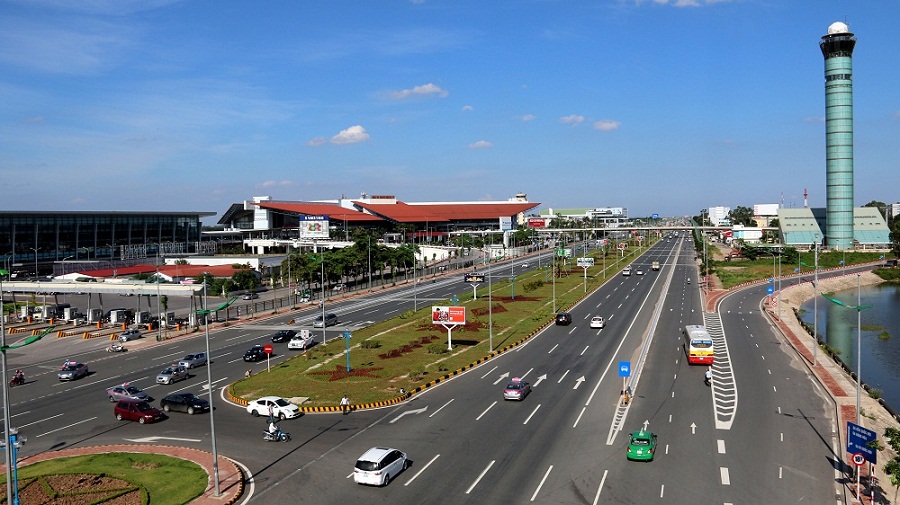
Since December 31, 2014, Terminal T1 has served domestic flights only, as all international flights were transferred to Terminal T2.
- Check-in counters: 99 check-in counters are located across Concourses A, B, and E. In addition, there are 67 self-service check-in kiosks operated by airlines (VietJet Air, Vietnam Airlines, and Bamboo Airways).
- Baggage claim belts: There are 8 baggage claim belts for arriving passengers, including 3 in Concourse A, 3 in Concourse B, and 2 in Concourse E.
- Flight Information Display System (FIDS): A total of 210 display screens are installed at all necessary locations, such as public halls, check-in counters, waiting lounges, boarding gates, and baggage claim areas.
- Boarding gates: There are 17 boarding gates, numbered from 1 to 17.
- Terminal information counters: 3 information counters are located on Level 1 of Area C, Level 2 of Area C, and the connecting area on Level 2 between Concourses A and E.
- Medical room: 1 medical room is located on Level 1 of Concourse A (adjacent to the internal passageway).
- Lost baggage counters: There are 5 lost baggage counters in the domestic arrivals restricted area, including 3 counters on Level 1 of Concourse C and 2 counters on Level 1 of Concourse E.
International Passenger Terminal (T2):
Passenger Terminal T2 was officially put into operation on 25 December 2014. The terminal was designed with four above-ground floors (excluding the basement) in a wing-shaped layout, reflecting the concept of harmony with nature, maximizing natural light, and saving energy. It has a length of 1,160 metres, a height of 29 metres, a total floor area of 200,316 square metres, and a handling capacity of 15 million passengers per year (for the period from 2020 to 2030).
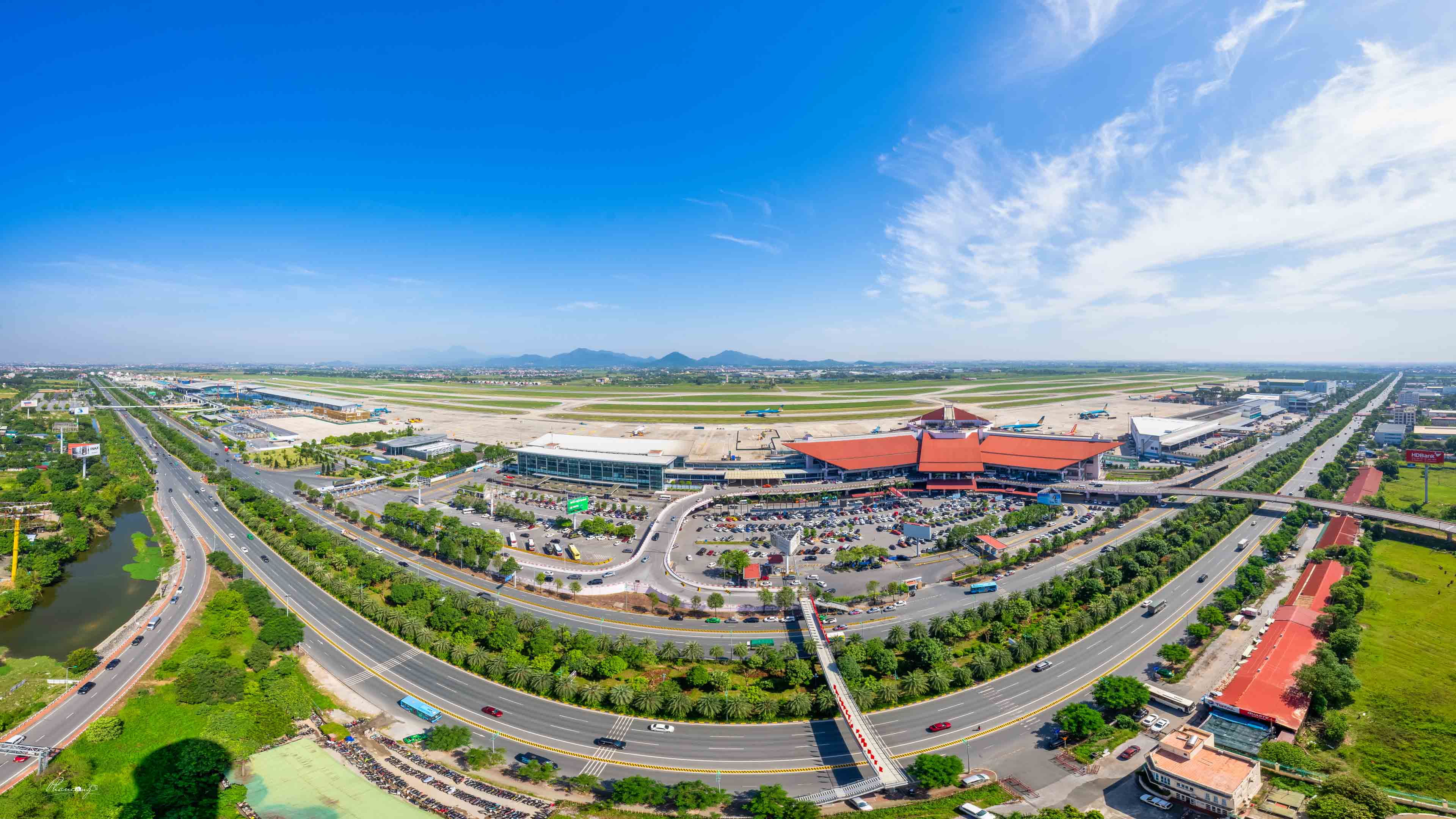
Terminal T2 is fully equipped with modern and advanced specialized aviation systems, including: the Baggage Handling System (BHS), comprising a Central Control Room and four sub-systems; the Airport Security System (ASS), featuring five screening levels, including automatic explosive detection; and the Passenger Boarding Bridge (PBB) system, consisting of 14 bridges integrated with the Visual Docking Guidance System (VDGS), Building Management System (BMS), and Flight Information Display System (FIDS).
Each passenger boarding bridge consists of two telescopic jet bridge tunnels and synchronized aircraft service equipment, including GPU, PCA, and PWS. The terminal is also equipped with 18 automatic aircraft docking guidance devices and 22 aircraft stand information signs (ASIS); 283 flight information display screens installed at all necessary locations such as public halls, check-in counters, waiting lounges, boarding gates, and baggage claim areas; 96 airline check-in counters and 10 self check-in kiosks for departing passengers; and a master clock system with GPS signal receivers to synchronize time data from satellites, ensuring accurate time updates in line with airports worldwide.
The CCTV surveillance system is connected to the Access Control System (ACS); the Public Address System (PAS) includes 41 announcement zones, equipped with noise-sensing microphones that automatically adjust sound volume; the Public Television System (PTVIS) is capable of broadcasting different programmes in different areas and displaying multiple contents from various programme sources according to pre-set schedules; the Access Control System (ACS) is installed at passageways separating different security zones and monitors entry and exit rights through the reading and identification of authorized proximity cards; the wireless internet system can support up to 32,768 simultaneous users; 22 moving walkways assist passengers, staff, and cargo transport along the two long wings of the terminal; and the underground fuel hydrant system consists of valve pits installed beneath the apron, from which refuelling vehicles connect to aircraft wings.
Level 1: Reserved for international arrivals, with an area of 59,329 m². The two wings contain office areas and terminal technical areas. The central area includes the arrivals duty-free area, international arrivals greeting hall, baggage claim area, departing baggage island area, lost baggage storage, technical rooms, waiting area for buses, service area, staff rooms, restrooms, circulation areas, information counters, ticket counters, and shops.
Level 2: Reserved for international transfer/departing passengers and arriving passengers, with an area of 54,513 m². The two wings contain office areas on the south side and sterile areas on the north side. The central area includes the international transfer check-in area, immigration area, and public area with restaurants, shops, and other services.
Level 3: Reserved for international departures, with an area of 62,719 m². The two wings contain international departure sterile waiting lounges. The central area includes commercial and service areas, check-in area, security screening, customs, and emigration procedures.
Level 4: Reserved for business class lounges and commercial service areas, with an area of 17,278 m². This level includes office areas, VIP rooms, and commercial-service areas.
On peak days, the terminal can handle 30,000 passengers and 230 aircraft movements; during peak hours, it can accommodate 3,000 passengers and 23 aircraft movements. Its handling capacity was 10 million passengers per year during the period 2015–2020 and 15 million passengers per year during 2020–2030.
The terminal was designed in a linear layout with the concept of harmony with nature, maximum use of natural light, and energy efficiency, together with advanced aviation equipment and technological systems meeting international standards.
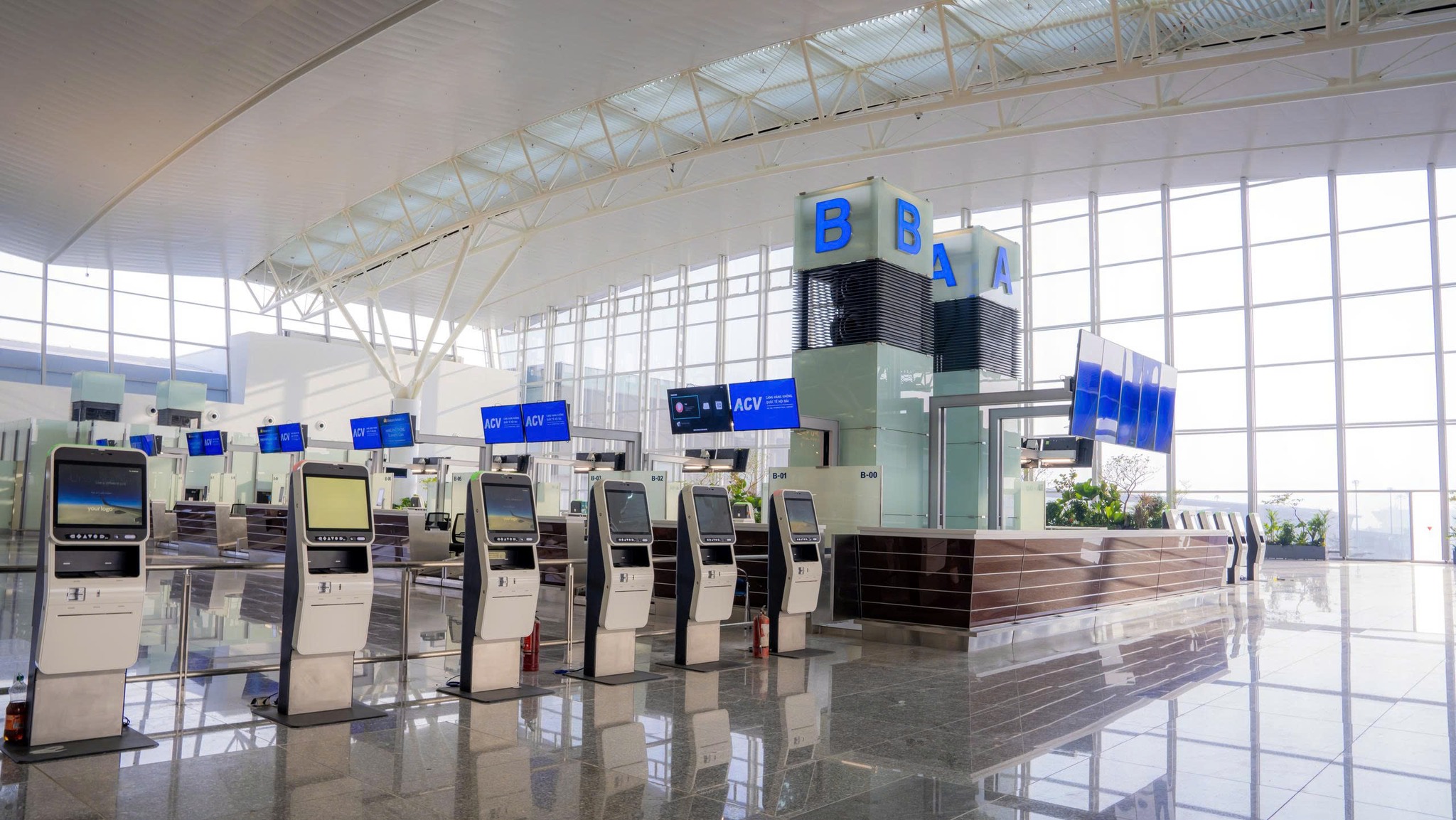
Check-in counters: 144 check-in counters are arranged across six islands: A/B, C/D, E/F, G/H, I/J, and K/L. In addition, there are 24 self check-in kiosks for passengers.
Baggage claim belts: There are 8 baggage claim belts for arriving passengers, numbered from 01 to 06.
Terminal information counters: 2 information counters, located on Level 1 and Level 3.
Border police counters: 52 counters for departure immigration procedures and 46 counters for arrival immigration procedures.
Medical rooms: 3 medical rooms, including 2 on Level 3 and 1 on Level 1.
Lost baggage counters: 4 lost baggage counters on Level 1.
Boarding gates: 17 boarding gates, numbered from 21 to 50.