
 22°C
|
°F
HA NOI
22°C
|
°F

About 40 km northwest of the capital city of Ha Noi, Non Nuoc Pagoda is located in Soc Son Commune, Soc Son District. Situated within the sacred Soc Temple complex, the pagoda stands at an elevation of about 110 m above sea level, nestled among an arc-shaped mountain range and resembling a person seated on a throne, facing the clear blue lake below. This is an auspicious site in the Eastern feng shui tradition: a dragon facing forward and a tiger crouching.
Unique architecture steeped in tradition
Non Nuoc Pagoda impresses visitors with its ancient and majestic architecture. The main hall covers an area of 260 m² and stands 14 m tall. It was built using rare traditional materials, including 600 m³ of ironwood, 300 m³ of green stone and 30 tonnes of bronze for casting statues. The pagoda roof features a traditional official's-hat design, with gracefully curved ridges and dragon-shaped ornaments at the corners, symbolising authority and permanence.
The most striking feature is the array of 80 ironwood pillars in the main hall—the largest number of ironwood pillars in a single pagoda in Vietnam. Each pillar is about 13 m long and more than 35 cm in diameter, giving the worship space a sense of solidity, majesty and solemnity.
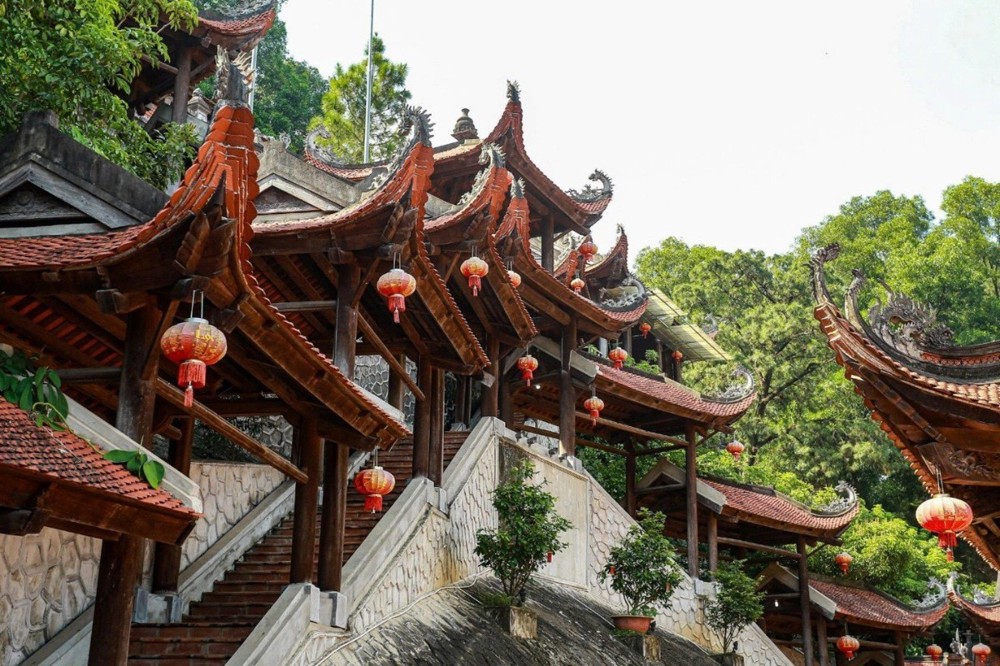
The pagoda also houses Vietnam's largest solid-bronze statue of the Buddha Tathagata, weighing about 30 tonnes and standing 6.5 m tall. It is solemnly placed at the centre of the main hall. The statue is not only spiritually significant but also a notable work of contemporary Buddhist sculpture.
A place preserving history and the lives of eminent monks
Non Nuoc Pagoda is not only an important religious centre but is also deeply connected with the history of Buddhism in Vietnam. According to ancient sources such as Thien Uyen Tap Anh and Dai Viet Su Ky Toan Thu, the pagoda's first abbot was Zen Master Ngo Chan Luu (933 - 1011), a descendant of Ngo Quyen. King Dinh Tien Hoang bestowed upon him the title Khuong Viet National Master, making him the first national master in Vietnamese history.
He was a highly virtuous senior monk who made major contributions to supporting the Dinh, Early Le and Ly dynasties. Together with Zen Master Van Hanh, Khuong Viet National Master helped establish the path that enabled Ly Cong Uan to ascend the throne and found the Ly dynasty, whose approach to governance linked Buddhist principles with national law. In recognition of his exceptional role and contributions, he was honoured as the “National Master of Three Dynasties,” a rare title in the history of Vietnamese Buddhism.
Renowned not only for its architecture and historical significance, Non Nuoc Pagoda is also a tranquil, peaceful place where visitors can find calm, enjoy the scenery and immerse themselves in the fresh mountain and forest environment. The pagoda complex lies in a spacious valley surrounded by green woodland and clear blue lakes, creating an open and serene atmosphere.
Ms. Nguyen Thuy Linh, a visitor from Hai Duong, shared: “Non Nuoc Pagoda has beautiful scenery. We enjoyed the fresh, quiet and peaceful atmosphere. There are also many trees, mountains and a lake here—coming to the pagoda makes all our fatigue disappear.”
In addition to the main hall, visitors can explore many other structures within the historic complex, including Trinh Temple (also known as Lower Temple), dedicated to the deity of Soc Mountain; Mother Temple, dedicated to the mother of Saint Giong; and Upper Temple, the main temple for commemorating and worshipping Phu Dong Heavenly King, also known as Saint Giong. The Saint Giong Monument is a cultural landmark symbolising the nation's indomitable spirit. The Vietnam Buddhist Academy is a training institution for Buddhist monks and nuns that closely connects traditional Buddhist study and practice with the modern era.
A crystallisation of national culture and spirituality
Non Nuoc Pagoda not only preserves sacred historical values but also symbolises the bond between religious life and everyday life, and between the people's hearts and the spirit of the mountains. Its harmonious architecture, beautiful natural setting and rich cultural and spiritual heritage have made it a source of pride for the capital city of Ha Noi and the Vietnamese nation as a whole.
In an era of rapid modern social development, pagodas such as Non Nuoc are becoming increasingly important: they provide spiritual support, preserve cultural identity and roots, and safeguard the nation's traditions handed down through generations.
According to the Magazine of Culture and Development.
Source: https://phatsuonline.vn/chua-non-nuoc-ngoi-co-tu-giua-nui-rung-thieng-soc-son-81